
The Symposium Native Museum of Bileća: architecture, role and significance in the context of the past and the need for establishment and reconstruction for the future was realized in the sense of calling public to discuss about public institutions. Dialogue between different professions in the complex process of revitalization and reconstruction, not only of buildings and institutions, but also of collective memory and common heritage. Organization: Museum of Herzegovina in Trebinje on the initiative of Biljana Jotić.
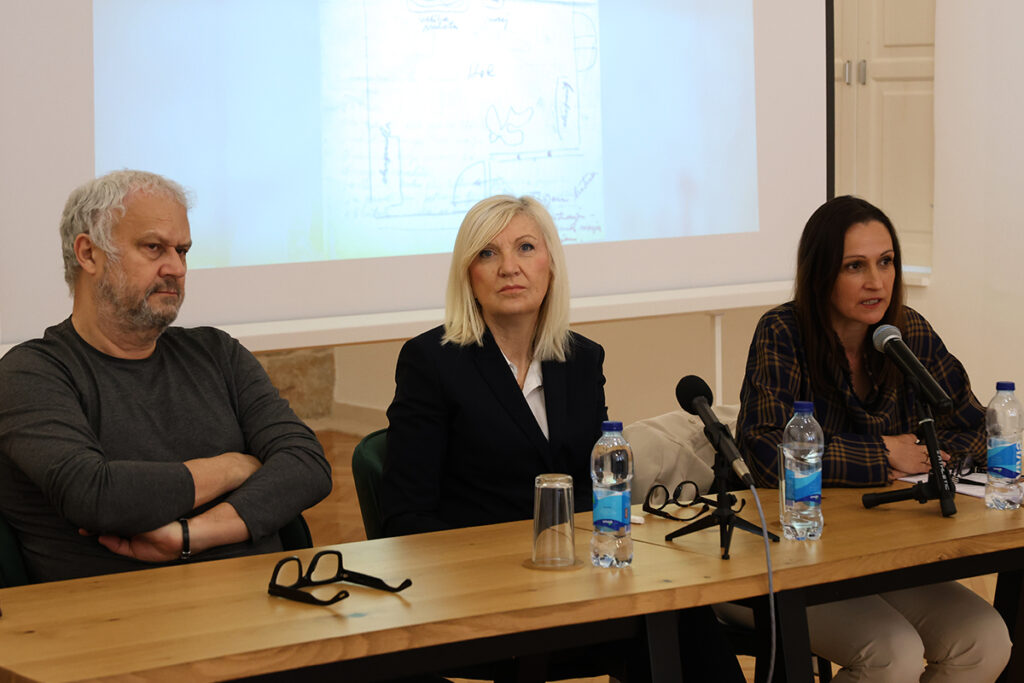
They talked about the museum – as a public institution and museology as a science and importancy of museum activities. About the architectural histriography and architectural heritage of authors Juraj Najdrhard and Živko Janić. About experiences during work, rules and procedures during the reconstruction of museums and other buildings that are monuments of the cultural heritage. About the importancy of the author’s architectural work and importancy of the respect a pripamary priniples of architectural historiography in the process of the reconstruction. About the role of architects in projects and execution of public purpose buildings. On the role of the Museum over time in creating heritage and educating the scientific, professional and general public about heritage. On the scientific approach of museology and the importance of preserving identity and heritage. On the importance of respecting transparency and publicity, as well as good practices of public tenders for public purpose institutions. On the necessity of determining the accuracy of data during research and correcting incorrect ones that are passed on as correct in the public about the award for a project solution.
Among the conclusions we highlight:
– to separate the institution of the Museum and the architecture of the object itself in the urban spatial unit of the Bileća Ethno Park, and observe both aspects in the context of respecting the primary principles of creation;
– consult scientific and professional associates in the field of museology and museum activity and encourage the employment of more professional staff;
– respect the publicity of the public institution’s actions and respect the good practice of public tenders for public institutions;
– consult the competent Museum, other municipal authorities, citizens of Bileća and the public;
– observe the building itself in the primary capacity of Serbian and Yugoslav built heritage and respect the authorship of professor Najdhard and the importance of collaborators Živko Janjić;
– to correct incorrect information that is disseminated as correct in the public in connection with the award for the project and dating;
– to give priority to the procedural flow from the project to the financial resources, instead of the other way around, from the provision of financial resources, and the integration of the project in relation to them;
The symposium began with a presentation by Ms. Biljana Jotić, On museology, architectural histriography and the importance of respecting the primary principle of the author Juraj Najdrhard, with reference to the role of Živko Janić; Biljane is an art historian, curator and PhD student at the Faculty of Philosophy in Belgrade, subject National History of Modern Architecture. She acquired relevant knowledge primarily in the capacity of director of the Museum of Applied Art in Belgrade, as well as being a member of the Council of the Faculty of Architecture in Belgrade. Among other things, it is important to note that she realized 5 national projects in the capacity of commissioner and curator, among which we highlight: Triennale of Design and Architecture in Milan (2022); Architecture Biennale in Venice (2023 and jury member for 2025); London Design Biennale (2023); Prague Quadrennial of Stage Design (2023).
It continued with the lecture of Prof. Jelene Ivanović Vojvodić, a full professor at the Faculty of Contemporary Arts in Belgrade. Here are some parts of her biography: after completing her architectural studies at the University of Belgrade, she worked at the Andrews Kalik and Associates office located in Reading, England, she was an independent designer at the CIP Traffic Institute in Belgrade, a senior designer at the Economic Bureau in Belgrade. Then she worked at Farman in Budapest, and then at the company Beogas-aquaterm in Belgrade. She was the president of the Society of Architects of Belgrade and a member of the Court of Honor of the Chamber of Engineers of Serbia. She is the founder, together with Goran Vojvodić, of the architectural company Biro.VIA d.o.o. in Belgrade, realized over 30 buildings, interiors and plans, of which two representative projects for the reconstruction of the Palace of Science and the Museum of the City of Belgrade stand out. She is the author and one of the founders of the BINA project (Belgrade International Week of Architecture) and the NGO organization Dokomomo Serbia. At the Faculty of Art and Design Megatrend (John Nesbitt) University, she worked as an assistant professor, associate professor, then full professor, dean and vice dean, and she is currently a full professor at the Faculty of Contemporary Arts in Belgrade. Winner of several awards.
Professor Ivan Rašković is employed as a full professor at the Faculty of Architecture, University of Belgrade, Department of Architecture. In addition to teaching, he does professional and theoretical work as a member of the AGM author group. He is the author of over twenty completed buildings and winner of six professional awards. He participated in 40 public, invitational and international competitions, where he was awarded nine time for the first and twenty for the second prizes and recognitions. He is a participant in the most important national and international exhibitions. Together with Professor Borislav Petrović, he published a monographic study TRADITION – TRANSITION / the use of heritage in architecture. Commissioner of the national pavilion at the 14th International Exhibition of Architecture Biennale in Venice. He is the president of the sub-section of architects, the section of designers of the Chamber of Engineers of Serbia. He was the first City Architect of Banja Luka. Among the realized objects of reconstruction and renovation of public buildings, the following stand out: the old Orthodox Theological Seminary and the Bishop’s Palace in Prizren. Then the inn of the Banjska monastery in Zvečan, Kosovo and Metohija. Reconstruction of the Museum building at the Mediajana archaeological site in Niš.
Symposium in the media:
